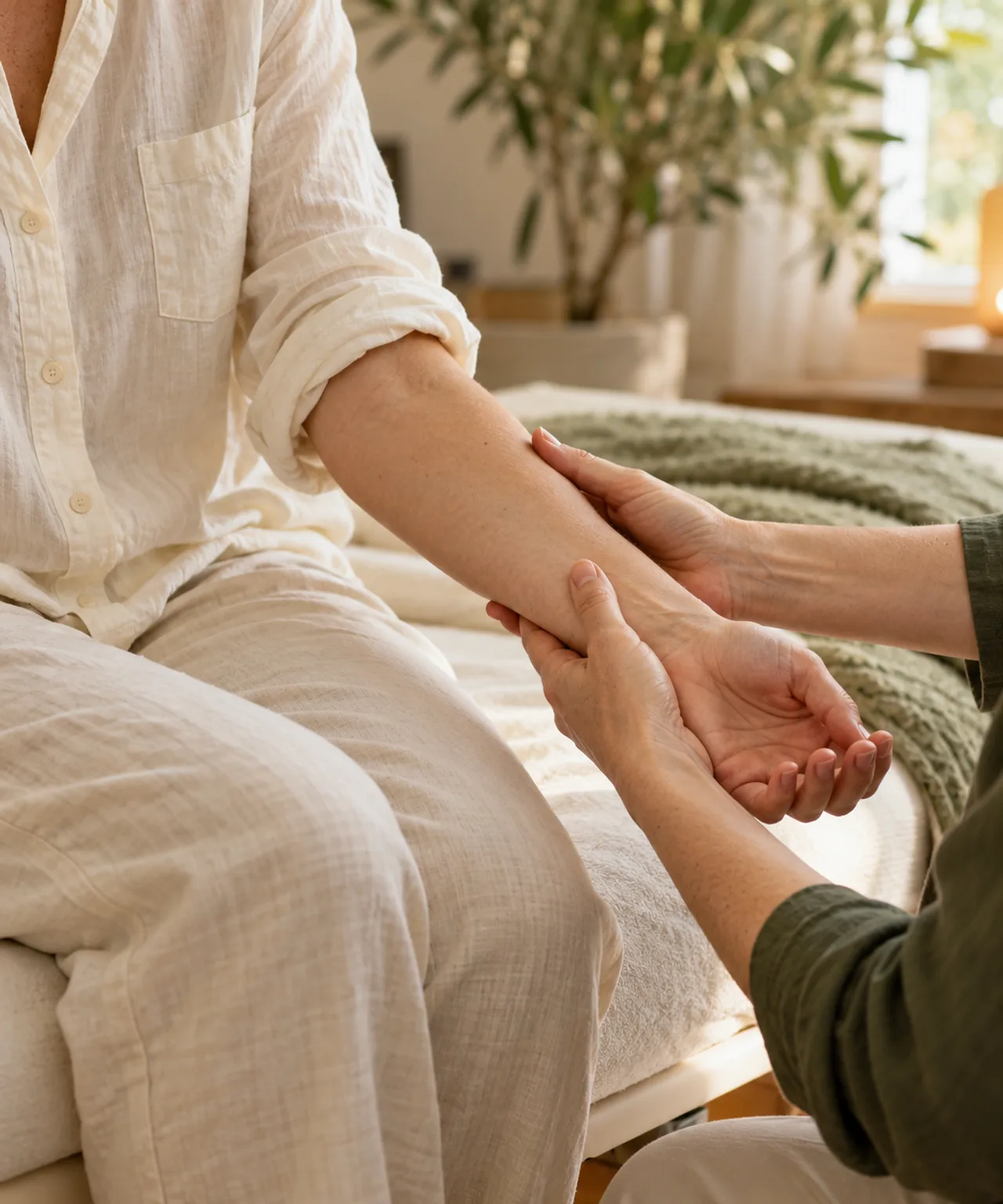
Kinetic Chain Release (KCR) is a structured sequence of gentle joint mobilisations and assisted stretches developed by Scottish physiotherapist Hugh Gilbert. With Dora, a session lasts around 60 minutes and costs £50, or £140 for three visits. You remain clothed, and treatment begins with a conversation about your needs and comfort.
What is Kinetic Chain Release?
KCR brings together joint mobilisation and supported stretching in a whole-body sequence. Rather than concentrating only on the area that feels tight, the approach considers how different areas move together. The KCR Academy teaches a 23-step protocol developed by Hugh Gilbert.
Joint mobilisation means guided movement of a joint; an assisted stretch means the practitioner supports a movement while you stay within a comfortable range. You do not need to be flexible or know the technical terms. People often explore KCR when stiffness or restricted movement makes ordinary activities feel less comfortable.
Where did KCR come from?
Scottish physiotherapist Hugh Gilbert developed Kinetic Chain Release following his work with movement and hands-on care. The approach became a taught protocol, allowing practitioners to learn a consistent sequence of mobilisations and stretches. Its name reflects the idea that the body’s movements are interconnected.
Today KCR is offered by practitioners from several care and bodywork backgrounds. Dora brings her own nursing experience and KCR practice to each visit, with attention to the person receiving care as well as the technique.
Care with Dora: experience, listening and mobility
Dora is a nurse and KCR therapist with over 25 years of experience across healthcare and healing disciplines. Her work has included caring for patients and supporting people with mobility difficulties. That experience informs a patient, attentive approach to understanding what feels difficult and what you hope to make easier.
The first conversation covers your goals, relevant health history, injuries, current care and comfort with different positions. There is space to explain practical needs, including getting on and off the treatment surface. Clients have described their experiences of Dora’s care in the reviews linked from this website; each person’s response to treatment is individual.
What happens during a KCR session?
Allow around 60 minutes for your visit, including the opening conversation and time to settle afterwards. Wear loose trousers and a comfortable top that let you move freely. You remain clothed and remove your shoes for treatment.
Dora explains the movements before beginning and guides you through the sequence. Expect supported movements and stretches rather than an oil massage. Communicate any discomfort straight away: your comfort and consent matter throughout, and a session can be paused or stopped. If the full protocol is unsuitable for your circumstances, a different care approach may be more appropriate.
At the end, take time to sit up and notice how ordinary movements feel. The conversation afterwards helps you decide whether a further visit would be useful. Connective tissue release can accompany KCR where appropriate.
What results can you reasonably expect?
Some people describe feeling more relaxed, less stiff or more comfortable moving after hands-on care. A useful way to review your own response is to notice an everyday activity: turning your head, rising from a chair or walking comfortably. Changes may be immediate, gradual or small, and some people notice little difference.
KCR does not guarantee permanent pain relief or a correction of every posture or movement problem. Independent clinical evidence for the specific protocol remains limited. It is complementary bodywork and should sit alongside appropriate medical assessment and any prescribed rehabilitation.
KCR, active lives and recovery from injury
Running, cycling, gym training and long hours at a desk can all shape how you experience stiffness. For an active person, a KCR visit provides supported movement and time to review comfort. It is different from sports massage, which commonly focuses on muscles using massage techniques.
A new sports injury, worsening pain or unexplained symptoms need clinical assessment before bodywork. For a settled injury, your diagnosis and rehabilitation advice guide whether a session is suitable. Continue exercises and return-to-sport guidance from your clinician; a comfortable session is not clearance to increase training.
After your visit and planning further sessions
Give yourself time to settle before returning to a busy day. Notice comfort during your usual activities and keep to any existing clinical advice. There is no need to force stretches or test your limits to prove the session has worked.
You can begin with one visit and review your response before choosing more. A three-session package is an option, rather than a requirement. New or concerning symptoms should be assessed by a healthcare professional instead of being treated as a necessary healing reaction.
KCR prices and appointments in Edinburgh
KCR costs £50 for a session of around 60 minutes. Three sessions cost £140. Connective tissue release is included with KCR where appropriate. These are the current prices, and no payment is taken through the website.
Dora’s practice is at 3 Alemoor Crescent, Edinburgh EH7 6UJ. Send your preferred date and time using the appointment form. Dora replies personally to agree the visit; submitting the form does not reserve a time. Home visits are available by arrangement, with travel and any additional charge agreed before booking.
Your questions, answered.
What is KCR in simple terms?
KCR is a hands-on sequence of gentle joint movements and assisted stretches. It considers movement across the body, with the practitioner supporting you through the sequence while you remain clothed.
Is KCR the same as physiotherapy?
No. KCR is a specific bodywork protocol developed by a physiotherapist. Dora is a nurse and KCR therapist; a KCR appointment is not a physiotherapy assessment or a prescribed rehabilitation programme.
What happens at my first appointment?
You discuss your goals, relevant health history and comfort with different positions. Dora explains the approach, guides the treatment when suitable, and leaves time to review how you feel afterwards. Allow around 60 minutes in total.
Do I stay clothed for KCR?
Yes. Wear loose, comfortable clothing that allows your arms and legs to move freely. Shoes are removed for the session.
Does KCR have to hurt to work?
No. Gentle movement should stay within a comfortable range. Pain is not a requirement, and you can pause or stop treatment at any time.
Will one KCR session fix my posture or pain?
A single visit may feel helpful, but neither immediate nor lasting improvement is guaranteed. Review comfort and everyday movement after the session rather than expecting a permanent correction. Persistent or worsening pain needs appropriate clinical assessment.
Can I request KCR after a sports injury?
A new injury should be assessed first. Once the injury is understood, suitability depends on the diagnosis, recovery stage and rehabilitation advice. KCR does not replace injury treatment or return-to-sport clearance.
How many sessions will I need?
Start with one session if you would like to understand the experience and review your response. There is no standard number that suits everyone. Three sessions are available as a £140 package, with each date arranged separately.
How much does KCR cost with Dora?
A session costs £50 and lasts around 60 minutes. A three-session package costs £140. Connective tissue release is included where appropriate. No payment is collected online.
Does Dora offer KCR home visits?
Home visits are available by arrangement. The travel area, access needs and any extra charge are agreed before the visit. Include a home-visit preference in your request.
Can someone with limited mobility enquire?
Yes. Dora has experience supporting people with mobility difficulties. Describe practical access and positioning needs in your enquiry so suitability can be discussed privately before treatment. Not every movement or approach will suit every person.
Can I combine KCR with another treatment?
Yes. Dora offers KCR + Bowen therapy or KCR + manual lymph drainage in one 90-minute visit at £70. The choice depends on your needs and suitability. Each is one combined session, not a multi-visit package.
Sources & further reading
Sources support the history and evidence discussed here. Practitioner or training organisations describe their own methods; independent clinical guidance is identified separately.
Educational information, not an individual medical assessment. Treatment begins with a private conversation about your needs, current care and suitability.
A conversation is a lovely beginning.
Ask about suitability, comfort and what happens next.
View the treatment & pricesRequest a visit